When Insurance Analytics Meets Snowflake: Multi-Cluster Architecture for Peak Moments
It is 9:00 a.m. on a major renewal day. Pricing wants fresh loss ratios before the leadership check‑in. Underwriting needs segment performance across multiple lines. Actuaries are recalibrating assumptions with the latest experience. BI has just pushed a new dashboard for distribution. Everything is running on the same data warehouse, everything is critical, and suddenly everything is slow.
This pattern is familiar in many insurance organizations. The more the business leans on analytics, the more the data platform struggles precisely during the moments that matter most: renewals, rate filings, portfolio reviews, catastrophe events, board reporting. The usual response is to blame queries, dashboards, or even teams, but in practice the root issue is architectural. A single monolithic warehouse is being asked to behave elastically in a world it was never designed for.
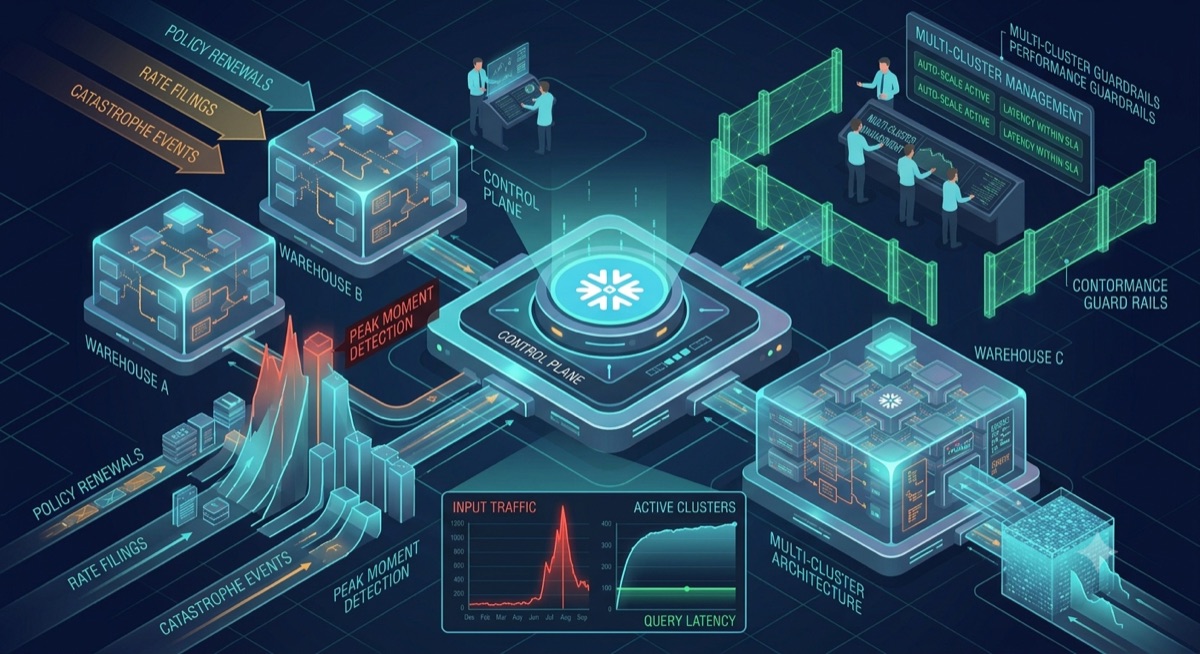
Snowflake’s multi‑cluster shared data architecture is one of the more practical answers to this problem. It allows insurance carriers and MGAs to separate the single source of truth they need for governance from the flexible compute they need for real‑world workloads. Instead of one overloaded system doing everything, you get one central place for data and multiple independent engines that can use it without fighting each other.
One Source of Truth, Many Engines
At the heart of Snowflake is a simple idea. All your policy, claims, exposure, and external data lives once in a central, optimized storage layer. That storage is columnar, compressed, encrypted, and managed for you. On top of that storage, you create multiple virtual warehouses. Each warehouse is its own compute cluster, with its own size, its own configuration, and its own workload, but all of them can see exactly the same data at the same time.
For an insurance analytics leader, this changes the conversation. You no longer have to decide whether ingestion from policy admin systems, actuarial reserving models, pricing simulations, and executive dashboards can coexist on one shared box without stepping on each other. You can give each of those domains its own virtual warehouse and let them operate independently while still aligning on shared definitions and shared data.
This is what Snowflake refers to as a multi‑cluster shared data architecture. The “shared data” part is about that single consolidated storage layer. The “multi‑cluster” part is about being able to scale compute horizontally by adding more clusters when you have high concurrency, then scaling back down when you do not.
Why CFOs and CUOs Care
From a CFO or CUO perspective, technology choices are ultimately financial and risk decisions. Traditional warehouses tend to be funded like buildings: you size for the worst case and live with the cost the rest of the year. Capacity is bought up front and sits there, under‑utilized, waiting for the next peak renewal season or regulatory deadline.
Snowflake changes this model. With multi‑cluster virtual warehouses, compute can expand only when the business is genuinely busy and contract when it is not. During a surge in submissions, a major storm, or a heavy period of simulation work, specific warehouses can scale out by adding clusters to absorb the load. When things quiet down, those clusters are automatically shut down and the spend disappears with them.
This turns infrastructure from a fixed, blunt expense into a metered, controllable one. Capacity becomes a lever you can align with the rhythm of your book rather than a sunk cost you hope to justify. You are no longer forced to choose between performance for critical analytics and financial discipline.
Oxygen for Data Engineers, Actuaries, and Analytics Teams
For data engineers and actuarial teams, the same architecture feels much less abstract. It simply removes a lot of operational friction. Ingestion from policy admin and claims systems can live on one warehouse tuned for heavy, continuous loads. Actuarial reserving and pricing models can run on another warehouse that is optimized for batch simulations and complex calculations. BI and self‑service analytics can operate on a third warehouse that is geared toward interactive workloads.
Because all of these warehouses sit on top of the same underlying data, the engineering team no longer needs to maintain fragile chains of replicated datasets just to keep performance acceptable. New data that lands in storage becomes available to every warehouse as soon as it is committed. Metrics, definitions, and lineage stay consistent even as compute patterns diverge.
The “multi‑cluster” part becomes particularly important during concurrency spikes. Imagine a catastrophe event when claims begin to rise sharply and leadership asks for near real‑time exposure and loss views. Snowflake can temporarily add clusters to the warehouse serving those critical dashboards. Queues drain, response times stay within expectations, and actuaries can continue to run their analyses. Once the surge passes, Snowflake removes the extra clusters and the associated cost ends along with them.
Designing Snowflake for Insurance Workloads
Getting value from Snowflake’s architecture in insurance is less about turning on every feature and more about designing around real workloads.
A typical pattern for an insurance analytics leader might be to establish a dedicated warehouse for ingesting data from policy, billing, and claims systems; another for actuarial and pricing workloads; and a third for reporting and self‑service analytics. Each warehouse can be sized and configured independently, with sensible auto‑suspend and auto‑resume settings so resources are not left running idle.
Multi‑cluster mode can then be enabled only where concurrency issues genuinely appear. For example, the reporting warehouse that serves underwriters, distribution, and executives might justify multi‑cluster scaling during known peak windows, such as morning hours on key renewal dates. The actuarial warehouse, which runs large but more predictable jobs, might benefit more from vertical scaling on a single cluster than horizontal scaling across many.
The goal is not to create an overly complex environment, but to give each critical domain the capacity, isolation, and responsiveness it needs, while still anchoring everyone to a single, governed source of truth.
Turning Architecture into Advantage
Every carrier and MGA today talks about being data‑driven. In practice, the organizations that succeed are often the ones that design their platforms around the realities of their business rather than around generic, one‑size‑fits‑all technology assumptions.
Snowflake’s multi‑cluster shared data architecture is a concrete way to do that for insurance. It respects the fact that quarter‑end is not the same as mid‑quarter, that catastrophe events do not behave like routine days, and that regulatory timelines do not move just because your warehouse is under strain. It gives CFOs control over spend, gives data engineers and actuaries the breathing room they need, and gives analytics leaders a platform that can support their promises to the business.
If your underwriters, actuaries, and BI teams are still negotiating “quiet hours” to run heavy jobs or being asked to avoid certain times of day, the problem is almost certainly architectural rather than organizational. At Metteyya Analytics, we help insurance organizations design Snowflake environments that reflect how their books actually behave, from renewal cycles and CAT seasons to regulatory reporting.
If you would like to review whether your current data architecture is ready for your next peak moment, we would be happy to talk.