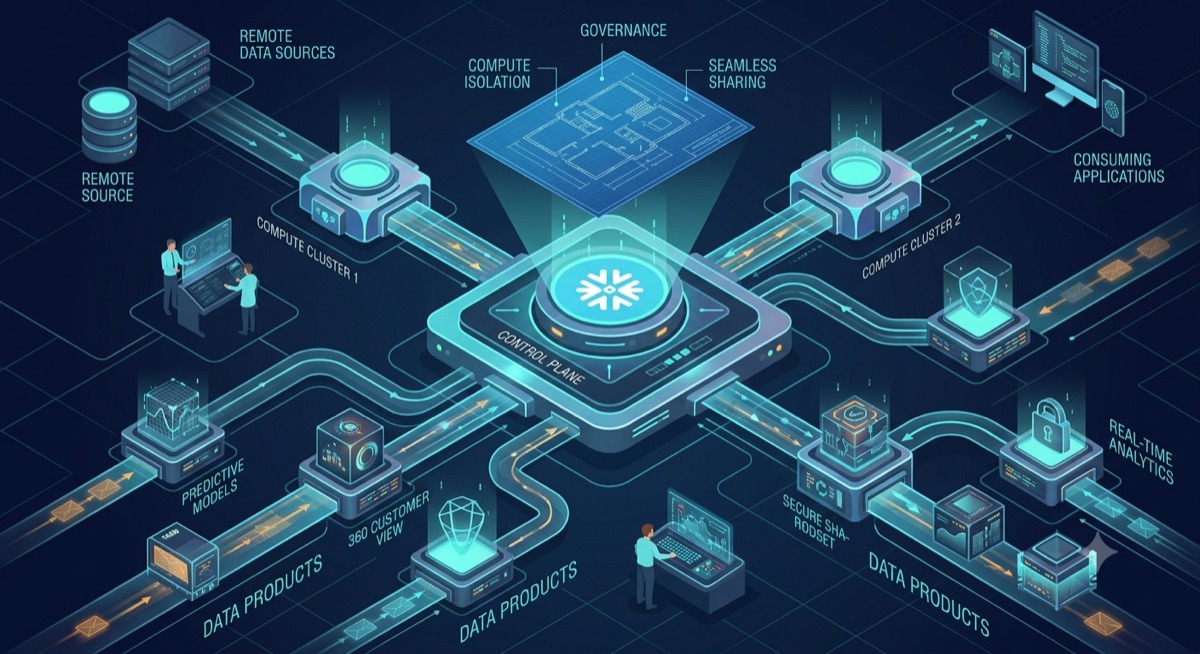
Snowflake: The Cloud Control Plane for Data Products
For decades, the data warehouse was a destination—a place where data went to be stored, structured, and eventually queried for BI reports. But as enterprises transition toward decentralized data architectures and data products, the role of the platform is shifting. Snowflake is no longer just a “warehouse” in the traditional sense; it has evolved into a cloud control plane for data products.
This shift changes how enterprises think about platform architecture. Instead of managing a monolithic database, architects are now managing a distributed ecosystem of data products, all governed and orchestrated through a single unified plane.
Beyond Storage: The Control Plane Concept
A control plane is responsible for management, governance, and policy enforcement across a distributed system. In the context of data, Snowflake provides the orchestration layer that allows independent teams to build, deploy, and share data products without the traditional overhead of infrastructure management.
Four key pillars enable this transition: compute isolation, unified governance, seamless sharing, and architectural flexibility.
1. Compute Isolation: The End of Resource Contention
In a traditional warehouse, a heavy data science job could easily starve an executive dashboard of resources. Snowflake’s multi-cluster shared data architecture solves this through true compute isolation.
By decoupling storage from compute, Snowflake allows you to spin up independent “Virtual Warehouses” for different workloads.
- Ingestion can run on its own dedicated cluster.
- Data Science and ML workloads can scale vertically for heavy processing.
- Customer-facing Apps can have their own isolated compute to ensure low-latency performance.
Because these warehouses all point to the same governed data, there is no “data movement.” You gain the performance of siloed systems with the consistency of a unified platform.
2. Governance at Scale: “Policy Once, Apply Everywhere”
As organizations move toward “Data Mesh” or “Data Fabric” patterns, governance often becomes the bottleneck. When every team has its own stack, enforcing global security policies is nearly impossible.
Snowflake acts as the control plane by centralizing the governance metadata while decentralizing the data ownership. Features like Row-Level Security (RLS), Dynamic Data Masking, and Object Tagging allow architects to define a policy once and have it enforced across every data product, regardless of which warehouse is accessing it. This provides the “guardrails” that allow teams to move fast without breaking compliance.
3. Data Sharing: Turning Data into a Product
The true power of a control plane is its ability to facilitate interaction between different parts of the system. Snowflake’s Secure Data Sharing eliminates the need for ETL/ELT when moving data between different departments or even different companies.
Instead of copying data, you are sharing access to the underlying storage metadata. This allows for:
- Instant internal sharing: Finance and Marketing see the same “Customer” product instantly.
- External Data Products: Sharing live datasets with partners or customers via the Snowflake Marketplace or Private Exchanges.
- Consistency: If the source data changes, the “subscriber” sees the update immediately. No more “stale data” tickets.
4. Changing Enterprise Architecture
For enterprise architects, this means moving away from “The Big Box in the Middle” toward a Universal Data Plane. In this new model:
- Storage is a Commodity: Data stays in its optimized, governed state.
- Compute is a Utility: It scales up and down based on the specific needs of the product.
- Metadata is the Engine: The control plane uses metadata to handle security, lineage, and discovery.
This architecture enables Data Product Thinking. Each team can own their domain, manage their own compute costs, and deliver high-quality data products, while the central platform team focuses on the “Control Plane”—ensuring the integrity, security, and availability of the entire ecosystem.
Conclusion
The transition from a “data warehouse” to a “cloud control plane” is more than just marketing; it is a fundamental shift in how we build data-intensive applications. By leveraging compute isolation, unified governance, and seamless sharing, enterprises can finally break down silos and treat data as the strategic product it was always meant to be.
At Metteyya Analytics, we help organizations navigate this architectural shift, moving from legacy bottlenecks to a modern, scalable data plane. If you’re ready to rethink your data platform, let’s connect.